Gold Buyers
Nov 03, 2026
What Is The Difference Between Scrap Gold And Investment Gold?
Gold has been appreciated throughout history due to its aesthetic qualities, scarcity, and potential as a store of monetary value. As such, if you possess any form of gold (e.g., used jewellery, damaged gold chains, unwanted rings or gold bars), you might be interested in determining the current worth of your gold and whether bars), you might be interested in determining the current worth of your gold and if it could potentially serve as an investment.
The price of gold varies based on its type. There are two primary types of gold that you need to be aware of: investment-grade gold and scrap gold. While both contain the same amount of gold, they are used for different purposes, require varying levels of quality, have different pricing structures, and offer varying levels of resale value.
Understanding how each of the types of gold is different from each other will allow you to make more informed choices when you sell old jewellery that you no longer want, purchase new gold products, or look into options for protecting your money.
We will teach you about scrap and investment gold, how to value both, and which is better for your goals.
Gold scrap is the gold in items that you don't want, use, or need anymore. The items can be damaged, old-fashioned, broken, or just don't fit into your current lifestyle.
Scrap gold is valued by its gold content, not its form, look, or purpose.
Common examples of scrap gold include:
Scrap gold may have various levels of purity, such as 9ct, 14ct, 18ct, and 22ct. The value of scrap gold will depend mostly on the amount of gold contained within it, how much it weighs, and what is currently the price of gold per ounce.
The amount of pure gold in an 18ct gold ring is 75%, whereas the amount of pure gold in a 9ct gold ring is 37.5%. Consequently, although two rings may weigh identically, they can have differing scrap values due to the difference in the purity of the gold.
An important consideration: Scrap gold does not always represent low-grade gold. Scrap gold is defined by the value of the gold that can be recovered from the item, rather than the item's overall quality.
Read More: How Much Is My Gold Worth? Understanding Gold Prices, Purity And Weight
Investment gold is gold that is bought mainly to maintain its monetary worth or possibly take advantage of the fluctuations in the gold market.
Investment gold has many characteristics that differ from scrap gold. For example, investment gold typically comes in a standard form, is manufactured to certain standards of purity, and has a well-defined weight.
Popular examples include:
Investment gold is typically purchased to maintain wealth, to diversify a portfolio or to plan for one's long-term finances.
UK qualifying investment gold has specific VAT treatments. Some types of qualifying investment in gold (such as those qualifying for exemption under HMRC rules) may be exempt from VAT. Not all gold coins and gold products will automatically qualify.
Investment gold is bought mostly as an investment, not for making jewellery or decoration. There are also some recognised products that can be priced at a higher rate than the actual value of gold.
Investment gold is mostly bought as an investment, not for making jewellery or decorations.
The two groups differ in how the gold is used. There are many distinctions between the two groups.
Additional value (sometimes) can be obtained through the design or antique nature of an item. A premium may be paid for products that are well known.
Usually resold to gold dealers/refineries Usually sold via gold/silver bullion dealers
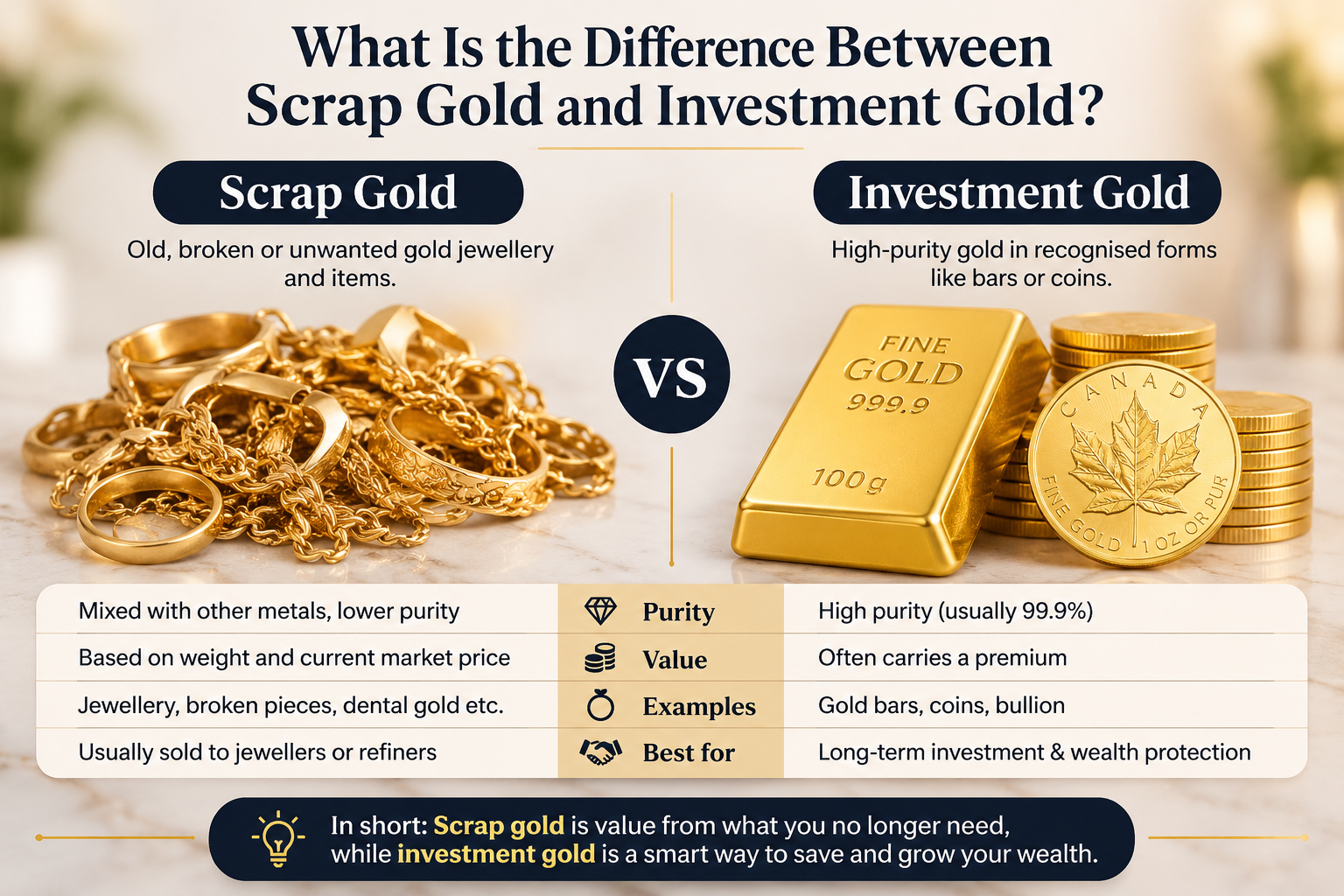
The most significant distinction between the two types of gold is that scrap gold is primarily appraised by the amount of gold that can be recovered from it, while investment gold is acquired as a monetary investment.
Scrap gold value is based upon the weight of the item, the purity of the metal and the current price of gold.
Let's understand each factor.
Gold purity
The amount of actual gold in an item depends on its purity. Most of the gold jewellery found in the United Kingdom comes in various carat levels.
Often you can tell what level of purity your gold has by looking at its hallmark. The United Kingdom's hallmark shows the amount of precious metal contained in the piece of jewellery.
Weight
When evaluating the worth of jewellery, the weight of gold used is typically measured in grams. The more genuine gold present in a piece of jewellery, the higher the possibility of obtaining a larger sum for the scrap metal.
However, keep in mind that non-gold items (such as gemstones) and other components of a piece of jewellery are usually not counted as part of the total gold weight.
Current gold price
An example would be a 10-gram piece of 18-karat gold, which has about 7.5 grams of pure gold.
Gold buyers will usually start with the current market value of gold and then adjust that for their own buying margin, refining cost and other fees.
An example would be a 10-gram piece of 18-karat gold, which has about 7.5 grams of pure gold. The theoretical metal value of that item could be estimated based on the going rate for a gram of pure gold at that time.
However, the actual amount offered by a buyer may be lower.
Buyers of investment-grade gold evaluate it based on several criteria in addition to its pure gold value.
The main factors include:
Gold purity and weight
Investment-grade gold bars will usually be of a minimum purity of 99.5% and subject to the appropriate UK VAT provisions.
Market price
The value of the gold you hold in your portfolio is affected by the international gold market. As the price of gold increases or decreases, the intrinsic worth of what you own will also fluctuate.
Dealer premium
Investment gold products can be priced higher than the actual gold value of the product. That difference in price is called a premium.
The cost of creating the item, delivering it to customers, verifying that the customer is buying an authentic product, and paying the dealer are all potential expenses. The amount of money spent on these types of expenses will vary based on the type of item being produced and the person selling it.
Recognition and authenticity
Gold bars and coins produced by an accredited mint/refinery can provide a more reliable source of verification for buyers to determine whether they are purchasing authentic products. Additionally, buyers may wish to assess any documentation associated with the product, the packaging, and the product's overall condition.
In the UK, there are two types of qualifying investment gold bars that have to meet certain criteria, such as having a minimum fineness of 995 parts per thousand. There are also some gold coins that will be exempt from VAT as well.
Yes, scrap gold can be remelted and re-refined into a higher-purity form. This new gold can then be made into new jewellery, new bars of gold, or other gold-based items.
The process generally involves:
Even though you can simply melt down your old jewellery to produce gold, that alone will not convert your jewellery into an investment-grade gold product. The refined material must conform to the appropriate purity standards, physical shape, and weight requirements.
The correct option will vary based on your individual monetary objectives and the current state of your assets.
Scrap gold may be suitable if:
Before you sell your jewellery, see if it has other attributes that may increase its value. Some of these factors include design, craftsmanship, the use of precious stones and the age of the item. If the item is either an antique or designed by a well-known artist, it will likely have greater monetary value than the amount of money you would receive for scrapping it.
Investment gold may be suitable if:
It's also essential to realise that the price of gold can decrease just as much as increase. Investing in gold isn't guaranteed to make money, and how well suited it is to you will be based upon your personal situation and the amount of risk you're willing to take.
If you plan to get rid of your unwanted gold jewellery, spend a few minutes understanding what it is worth so that you can make an educated choice.
Here are some useful tips:
Final Thoughts
Scrap gold and investment gold can both contain precious metal, but they have two entirely different uses. Scrap gold is valued for its gold content and recyclability, while investment gold is bought for its potential profit.
Whether it's the old gold necklace that has been tucked away in your jewellery box or if you're considering buying gold bars, it will be very important for you to understand purity, weight and current market prices.
You must identify your assets, know their prices, and decide based on your needs.
Scrap gold is unwanted or damaged gold valued mainly for its metal content. Investment gold is purchased primarily to hold financial value, usually in the form of gold bars or qualifying bullion coins.
Not necessarily. Scrap gold is usually valued according to its gold content, while investment gold can include additional premiums for manufacturing, recognition and resale convenience.
Yes. 18ct gold jewellery can be sold as scrap gold. It contains 75% pure gold, and its value depends on its weight and the current gold price.
24ct gold has a high purity level, but investment suitability also depends on the product, purchase premium, resale costs and market conditions.
Yes. Broken gold jewellery can still have value because buyers may recover and refine the precious metal.
The price of gold varies based on its type. There are two primary types of gold that you need to be aware of: investment-grade gold and scrap gold. While both contain the same amount of gold, they are used for different purposes, require varying levels of quality, have different pricing structures, and offer varying levels of resale value.
Understanding how each of the types of gold is different from each other will allow you to make more informed choices when you sell old jewellery that you no longer want, purchase new gold products, or look into options for protecting your money.
We will teach you about scrap and investment gold, how to value both, and which is better for your goals.
What Is Scrap Gold?
Gold scrap is the gold in items that you don't want, use, or need anymore. The items can be damaged, old-fashioned, broken, or just don't fit into your current lifestyle.
Scrap gold is valued by its gold content, not its form, look, or purpose.
Common examples of scrap gold include:
- Broken gold chains and bracelets.
- Old or unwanted gold rings.
- Single gold earrings without their matching pair.
- Damaged necklaces and pendants.
- Outdated gold jewellery.
- Gold items that cannot easily be repaired or resold.
Scrap gold may have various levels of purity, such as 9ct, 14ct, 18ct, and 22ct. The value of scrap gold will depend mostly on the amount of gold contained within it, how much it weighs, and what is currently the price of gold per ounce.
The amount of pure gold in an 18ct gold ring is 75%, whereas the amount of pure gold in a 9ct gold ring is 37.5%. Consequently, although two rings may weigh identically, they can have differing scrap values due to the difference in the purity of the gold.
An important consideration: Scrap gold does not always represent low-grade gold. Scrap gold is defined by the value of the gold that can be recovered from the item, rather than the item's overall quality.
Read More: How Much Is My Gold Worth? Understanding Gold Prices, Purity And Weight
What Is Investment Gold?
Investment gold is gold that is bought mainly to maintain its monetary worth or possibly take advantage of the fluctuations in the gold market.
Investment gold has many characteristics that differ from scrap gold. For example, investment gold typically comes in a standard form, is manufactured to certain standards of purity, and has a well-defined weight.
Popular examples include:
- Gold bars and bullion bars.
- Gold coins, such as Britannias and Sovereigns.
- Recognised investment-grade gold products.
Investment gold is typically purchased to maintain wealth, to diversify a portfolio or to plan for one's long-term finances.
UK qualifying investment gold has specific VAT treatments. Some types of qualifying investment in gold (such as those qualifying for exemption under HMRC rules) may be exempt from VAT. Not all gold coins and gold products will automatically qualify.
Investment gold is bought mostly as an investment, not for making jewellery or decoration. There are also some recognised products that can be priced at a higher rate than the actual value of gold.
Investment gold is mostly bought as an investment, not for making jewellery or decorations.
Scrap Gold vs Investment Gold: What Are the Main Differences?
The two groups differ in how the gold is used. There are many distinctions between the two groups.
Feature Scrap Gold Investment
- Main purpose: recycling or recovering gold Wealth preservation and investment
- Gold comes in various forms, such as old jewellery, broken chains, rings, and more. Gold bars and eligible bullion coins
- Valuation: Value of gold based on weight, purity and market price. Value of gold based on market price, weight, purity and the product premium.
- Condition: often damaged or unwanted Usually sold in recognised investment forms
- The purity of gold bars is typically 99.5% or above, with common options being 9ct, 18ct, and 22ct.
Additional value (sometimes) can be obtained through the design or antique nature of an item. A premium may be paid for products that are well known.
Usually resold to gold dealers/refineries Usually sold via gold/silver bullion dealers
The most significant distinction between the two types of gold is that scrap gold is primarily appraised by the amount of gold that can be recovered from it, while investment gold is acquired as a monetary investment.
How Is Scrap Gold Valued?
Scrap gold value is based upon the weight of the item, the purity of the metal and the current price of gold.
Let's understand each factor.
Gold purity
The amount of actual gold in an item depends on its purity. Most of the gold jewellery found in the United Kingdom comes in various carat levels.
- 9 ct gold contains 37.5% pure gold.
- 14 ct gold contains 58.5% pure gold.
- 18ct gold contains 75% pure gold.
- 22 ct gold contains 91.6% pure gold.
- 24 ct gold is approximately 99.9% pure gold.
Often you can tell what level of purity your gold has by looking at its hallmark. The United Kingdom's hallmark shows the amount of precious metal contained in the piece of jewellery.
Weight
When evaluating the worth of jewellery, the weight of gold used is typically measured in grams. The more genuine gold present in a piece of jewellery, the higher the possibility of obtaining a larger sum for the scrap metal.
However, keep in mind that non-gold items (such as gemstones) and other components of a piece of jewellery are usually not counted as part of the total gold weight.
Current gold price
An example would be a 10-gram piece of 18-karat gold, which has about 7.5 grams of pure gold.
Gold buyers will usually start with the current market value of gold and then adjust that for their own buying margin, refining cost and other fees.
An example would be a 10-gram piece of 18-karat gold, which has about 7.5 grams of pure gold. The theoretical metal value of that item could be estimated based on the going rate for a gram of pure gold at that time.
However, the actual amount offered by a buyer may be lower.
How Is Investment Gold Valued?
Buyers of investment-grade gold evaluate it based on several criteria in addition to its pure gold value.
The main factors include:
Gold purity and weight
Investment-grade gold bars will usually be of a minimum purity of 99.5% and subject to the appropriate UK VAT provisions.
Market price
The value of the gold you hold in your portfolio is affected by the international gold market. As the price of gold increases or decreases, the intrinsic worth of what you own will also fluctuate.
Dealer premium
Investment gold products can be priced higher than the actual gold value of the product. That difference in price is called a premium.
The cost of creating the item, delivering it to customers, verifying that the customer is buying an authentic product, and paying the dealer are all potential expenses. The amount of money spent on these types of expenses will vary based on the type of item being produced and the person selling it.
Recognition and authenticity
Gold bars and coins produced by an accredited mint/refinery can provide a more reliable source of verification for buyers to determine whether they are purchasing authentic products. Additionally, buyers may wish to assess any documentation associated with the product, the packaging, and the product's overall condition.
In the UK, there are two types of qualifying investment gold bars that have to meet certain criteria, such as having a minimum fineness of 995 parts per thousand. There are also some gold coins that will be exempt from VAT as well.
Can Scrap Gold Be Converted into Investment Gold?
Yes, scrap gold can be remelted and re-refined into a higher-purity form. This new gold can then be made into new jewellery, new bars of gold, or other gold-based items.
The process generally involves:
- Collection: Unwanted gold jewellery and other scrap items are collected.
- Testing: The gold is assessed to establish its purity and composition.
- Melting: The material is melted to separate the gold from other components.
- Refining: Impurities and unwanted metals are removed.
- Manufacturing: Refined gold can be used to produce new gold products.
Even though you can simply melt down your old jewellery to produce gold, that alone will not convert your jewellery into an investment-grade gold product. The refined material must conform to the appropriate purity standards, physical shape, and weight requirements.
Which Is Better: Scrap Gold or Investment Gold?
The correct option will vary based on your individual monetary objectives and the current state of your assets.
Scrap gold may be suitable if:
- You have broken or unwanted gold jewellery.
- You want to turn unused gold items into cash.
- You have jewellery that you no longer wear.
- You want to understand the recoverable gold value of your belongings.
Before you sell your jewellery, see if it has other attributes that may increase its value. Some of these factors include design, craftsmanship, the use of precious stones and the age of the item. If the item is either an antique or designed by a well-known artist, it will likely have greater monetary value than the amount of money you would receive for scrapping it.
Investment gold may be suitable if:
- You want to hold physical gold as part of a wider financial strategy.
- You prefer recognised gold bars or bullion coins.
- You understand the costs of buying, storing and selling precious metals.
- You are comfortable with fluctuations in gold prices.
It's also essential to realise that the price of gold can decrease just as much as increase. Investing in gold isn't guaranteed to make money, and how well suited it is to you will be based upon your personal situation and the amount of risk you're willing to take.
Things to Consider Before Selling Scrap Gold
If you plan to get rid of your unwanted gold jewellery, spend a few minutes understanding what it is worth so that you can make an educated choice.
Here are some useful tips:
- Verify the hallmark: Search for stamps such as 375, 585, 750, and 916 to determine the level of purity of the gold.
- Compare gold buyers: Obtain quotes from more than one reputable gold buyer.
- Know the process of determining the value of your gold: enquire about how the buyer determines the gold's weight, purity, and, ultimately, what price they will pay for it.
- Look for added value: jewellery from designers, antiques and items containing precious stones can have greater value than the gold that is used to make them.
- Get the details on the charges: Before accepting an offer, find out if there will be any additional charges, such as for refining, etc.
- Do not sell your expensive jewellery too quickly. A clear assessment will show how much money is available for purchase.
Final Thoughts
Scrap gold and investment gold can both contain precious metal, but they have two entirely different uses. Scrap gold is valued for its gold content and recyclability, while investment gold is bought for its potential profit.
Whether it's the old gold necklace that has been tucked away in your jewellery box or if you're considering buying gold bars, it will be very important for you to understand purity, weight and current market prices.
You must identify your assets, know their prices, and decide based on your needs.
Frequently Asked Questions (AI Visibility FAQs)
1. What is the main difference between scrap gold and investment gold?
Scrap gold is unwanted or damaged gold valued mainly for its metal content. Investment gold is purchased primarily to hold financial value, usually in the form of gold bars or qualifying bullion coins.
2. Is scrap gold worth less than investment gold?
Not necessarily. Scrap gold is usually valued according to its gold content, while investment gold can include additional premiums for manufacturing, recognition and resale convenience.
3. Can I sell 18ct gold as scrap gold?
Yes. 18ct gold jewellery can be sold as scrap gold. It contains 75% pure gold, and its value depends on its weight and the current gold price.
4. Is 24ct gold better for investment?
24ct gold has a high purity level, but investment suitability also depends on the product, purchase premium, resale costs and market conditions.
5. Does broken gold jewellery have any value?
Yes. Broken gold jewellery can still have value because buyers may recover and refine the precious metal.